Is Technical Debt Real?
What the heck is technical debt? Technical debt creates overhead and friction on an organization and stifles innovation. This article provides some simple ways to identify, measure and reduce technical debt.
What Is Technical Debt?
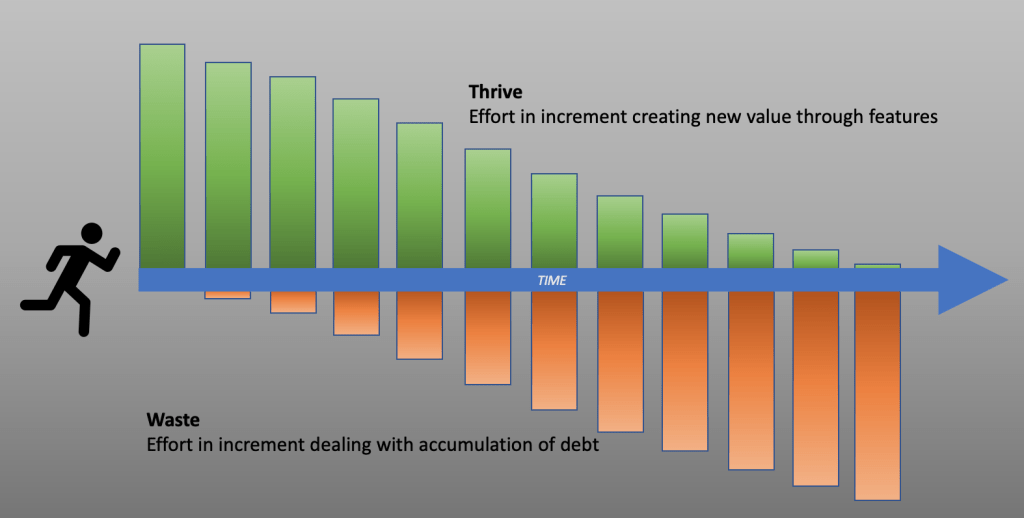
Technical debt is not a direct cost in financial terms, but rather a concept. Simply, technical debt creates overhead as a result of choosing the easier option in response to technology choices.
Let’s use the budget to invest in the shiny, new project this year and upgrade the database platform to the supported version, in the future, when we have time, later.
CEO, Delays Inc.
Technical debt is like credit card debt. It has a similar stifling affect on growth, much like the effect financial interest has on the prosperity of an individual or family. Without a plan for prevention, over time, technical debt will accumulate and grow, and prosperity will decline.
Identifying Technical Debt
Does your organization have technical debt? Unless you haven’t started to operate yet, the answer is likely yes.
User feedback is a great way to confirm if you have technical debt. Technical debt will take the form of frustration in the voice of your customers & business partners. If you hear things like “why do these feature requests take so too long?” or “even with significant investment, our product isn’t on par with the competition”, you likely are suffering from technical debt.
Measuring Technical Debt
What is your application or organization’s tech debt score? Let’s reconsider the metaphor comparing technical debt to personal financial credit card debt. Through the credit bureaus Experian, Equifax and Transunion, individuals are scored for credit worthiness based on accumulated debt and behaviors around that debt. Credit scores range from 400 to 800, with the higher number signaling better debt management behaviors. Lending organizations see this number as a key performance indicator and predictor of future behaviors, and subsequently use the credit score to make lending decisions. Individuals with higher scores get better rates, and can subsequently barrow money at a lower cost.
Tech Debt Score, by Smart Brains, is a simple scoring model to measure technical debt management behaviors. By way of introduction, Smart Brains is an open source company that runs a pretty tight ship when it comes to managing their technical debt (see their also fictitious 713 score below as definitive proof). Tech Debt Score provides a very simple and subjective way to measure your organization’s tech debt management worthiness across an ensemble of dimensions.
The Tech Debt Score model considers 8 dimensions to produce a value between 0-800. A higher score and the larger radar plot indicates maturity in the area of technical debt management. A lower score and smaller radar plot indicates lower maturity. The model considers the following dimensions:
- Coding practices, style & formatting
- Modularity & coupling
- Test coverage & automated testing
- Continuous integration & delivery
- Lifecycle
- Documentation
- Homogeneity of tech stack
- Complexity
Tech Debt Score can help you to measure your organization’s technical debt and create focus for areas to improve.