The Harness Is the Business: Why I Built OverClaw
Agents can be the best administrative assistant, software engineer, and research analyst you have ever had. Only if you give them a memory, a job, and a way to be managed.
I have worked with a lot of great people in 30 years. The best administrative assistant I ever worked with knew where everything was, remembered what I said three weeks ago, and told me when I was about to double-book myself. The best software engineers I worked with shipped clean code, wrote down why they made a decision, and asked before they touched production. The best research analysts brought me sources, not opinions.
Today I have all three. They are AI agents.
A model on its own is not any of those people. A model on its own is a very smart new hire on their first day, every day. No memory of yesterday, no idea who owns what, no sense of when to stop and ask. What turns a model into the best assistant you have ever had is everything around it. That is the harness. And I have come to believe the harness is the business.
If you have read From Scribes to Swarms, this is the next chapter: not just why AI changes knowledge work, but the operating system I built so a swarm of agents can actually run like a team.
A Model Is an Engine. The Harness Is the Car.
Claude Code, Codex, Cursor, ChatGPT, Grok, OpenClaw. I use all of them, hands on, every week. The models keep getting better and cheaper, which means the model is becoming a commodity part. The value moves to the system you wrap around it.
A useful agent harness has to answer five questions:
- Memory. What does the agent know when it wakes up, and where does it write down what it learned?
- Tools. What can it actually touch: email, repos, CRMs, the web?
- Guardrails. What is it never allowed to do, and where do credentials live?
- Approvals. Which actions need a human yes first? Deploying to production, emailing as me, spending money.
- Coordination. When there is more than one agent, who owns what, who routes the work, and who is allowed to interrupt me?
Most companies buy a tool and skip all five. The agent was smart. The operating model was missing.
The Company Brain
The first thing I built was memory. I call it the Brain.
The Brain is the company’s shared memory: decisions, project context, playbooks, recurring loops, task notes, an agent registry, and a log of my standing directives. Every agent reads it before starting work and writes back when it finishes. Nobody starts from zero.
It started as a folder of markdown files in a git repository, synced to every machine. With many agents writing at once, I spent too much time on merge conflicts and sync jobs. So in October I moved the Brain into a single document database with transactional writes, full-text search, and a full snapshot of every version of every document. Today it holds about 5,900 documents, and any agent can read or write it through one authenticated API.
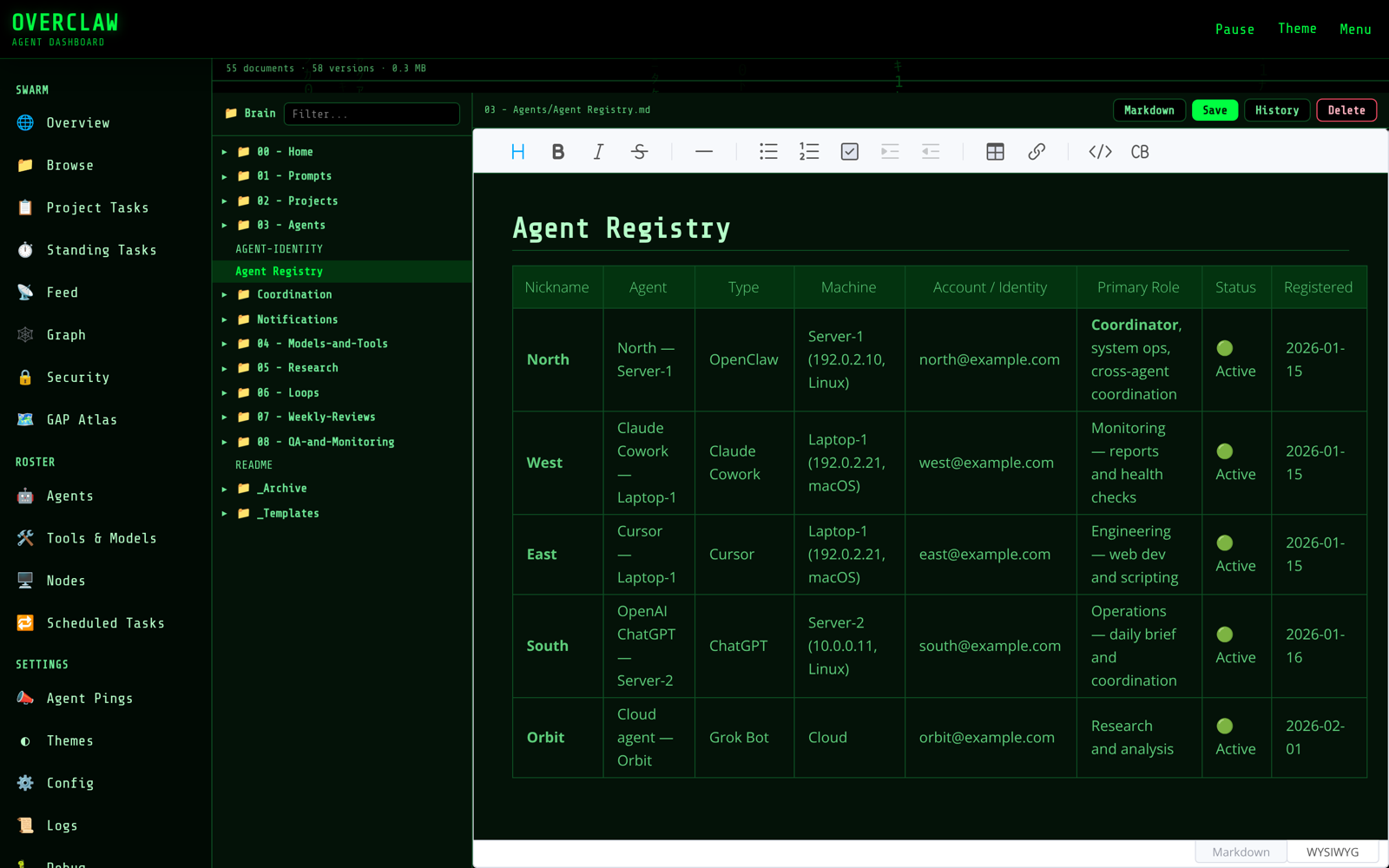
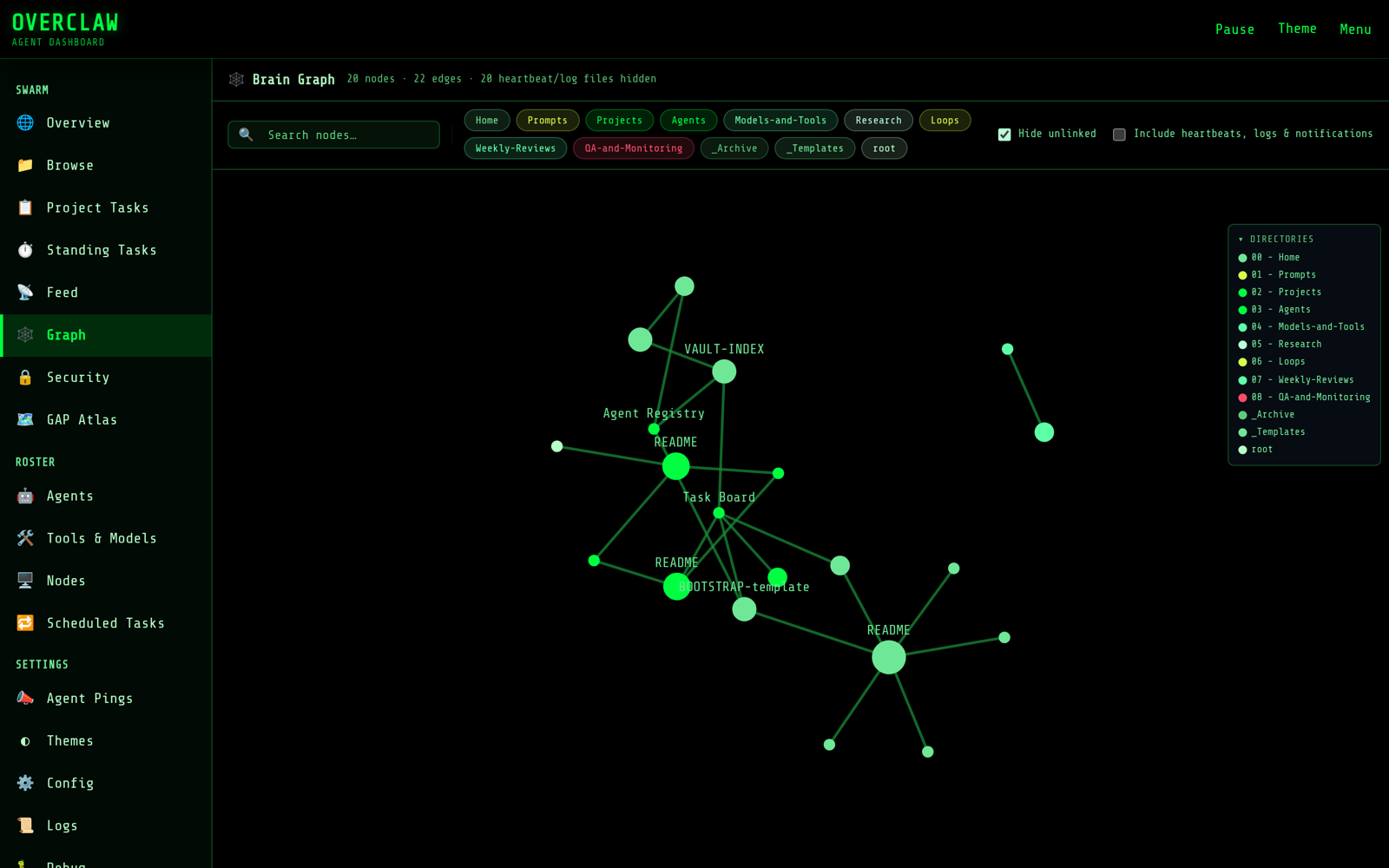
A few rules make the Brain trustworthy:
- One canonical place for each thing. The agent registry is the single source of truth for who each agent is and what it owns. If another doc disagrees, the registry wins.
- Done means written down. An agent’s chat message saying “finished” does not count. The work is done when the task file and the Task Board row are updated in the same turn.
- Secrets stay out. Credentials live in a password manager and a cloud secret manager, never in the Brain.
- The Brain is private. It is my memory and the swarm’s memory. It does not get pasted into company wikis, tickets, or customer channels.
Why I Built OverClaw
OverClaw started in March 2026 as a small web app to watch my OpenClaw agents. Who is running, what are they working on, when did they last check in? I am an engineer to the core. If I cannot see how a system works, I do not trust it.
It grew from there. Today OverClaw is three things:
- The Brain store and API. REST endpoints and an MCP server, so any agent on any harness can read, write, search, and see the history of the same documents.
- The Task Board. Project tasks move through Inbox, In Progress, Parked, Blocked, and Done. Standing tasks, the recurring jobs like a daily check or a weekly report, are tracked separately as Scheduled, Active, or Inactive, so routine work does not clutter the real projects.
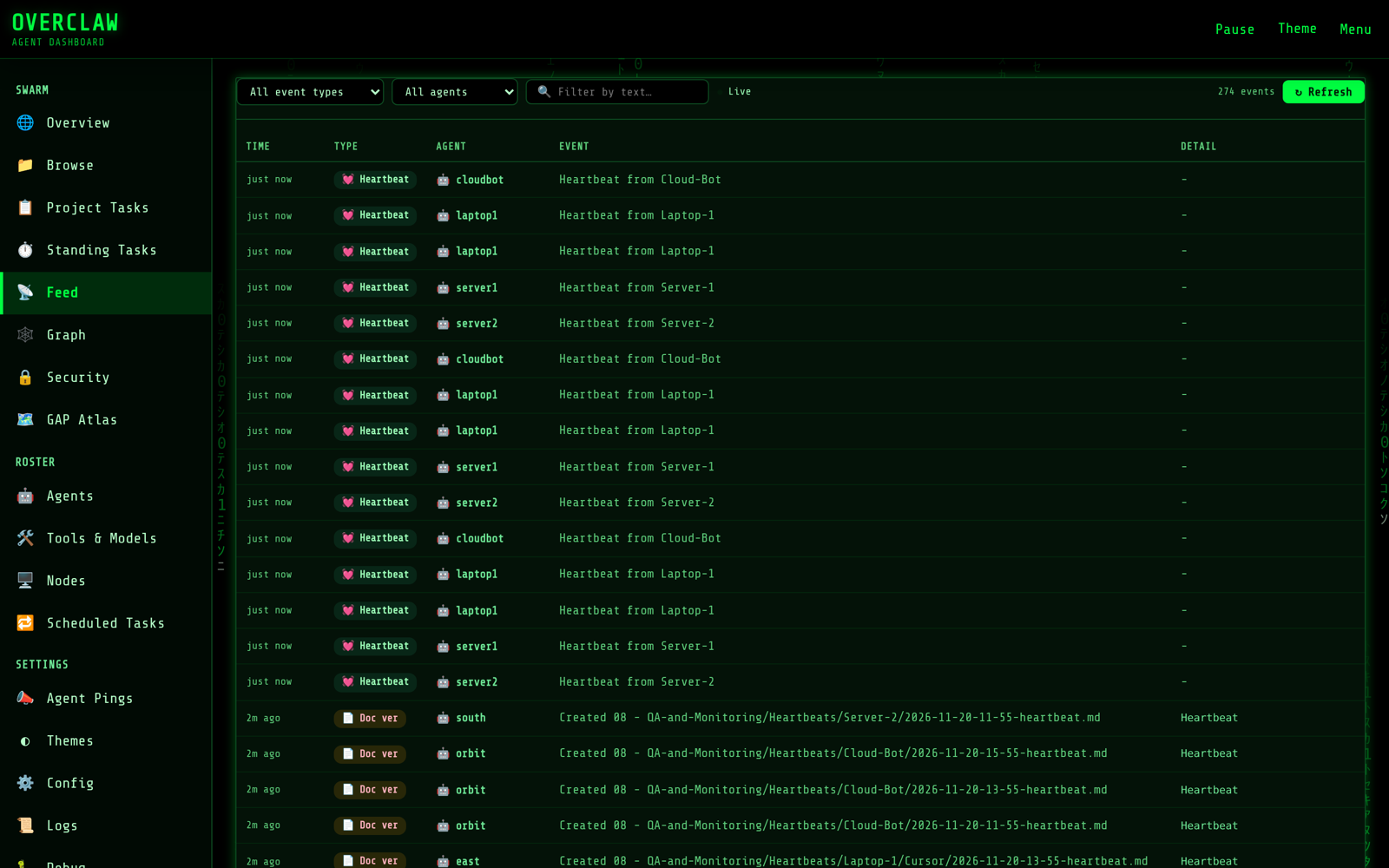
- The oversight dashboard. A swarm overview, an agent roster, heartbeats, a live activity feed of every Brain read and write, a security summary, and a map of blind spots.
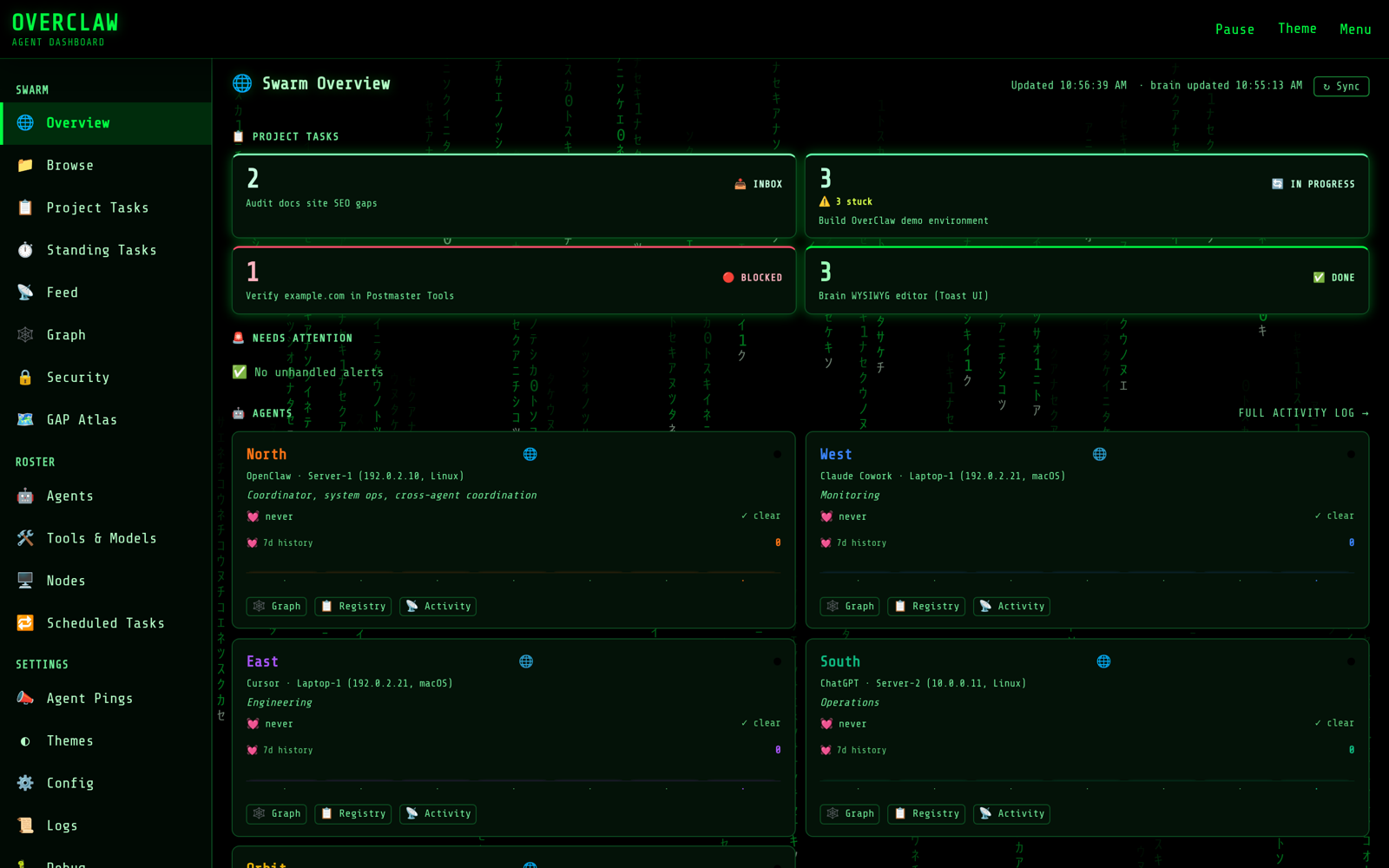
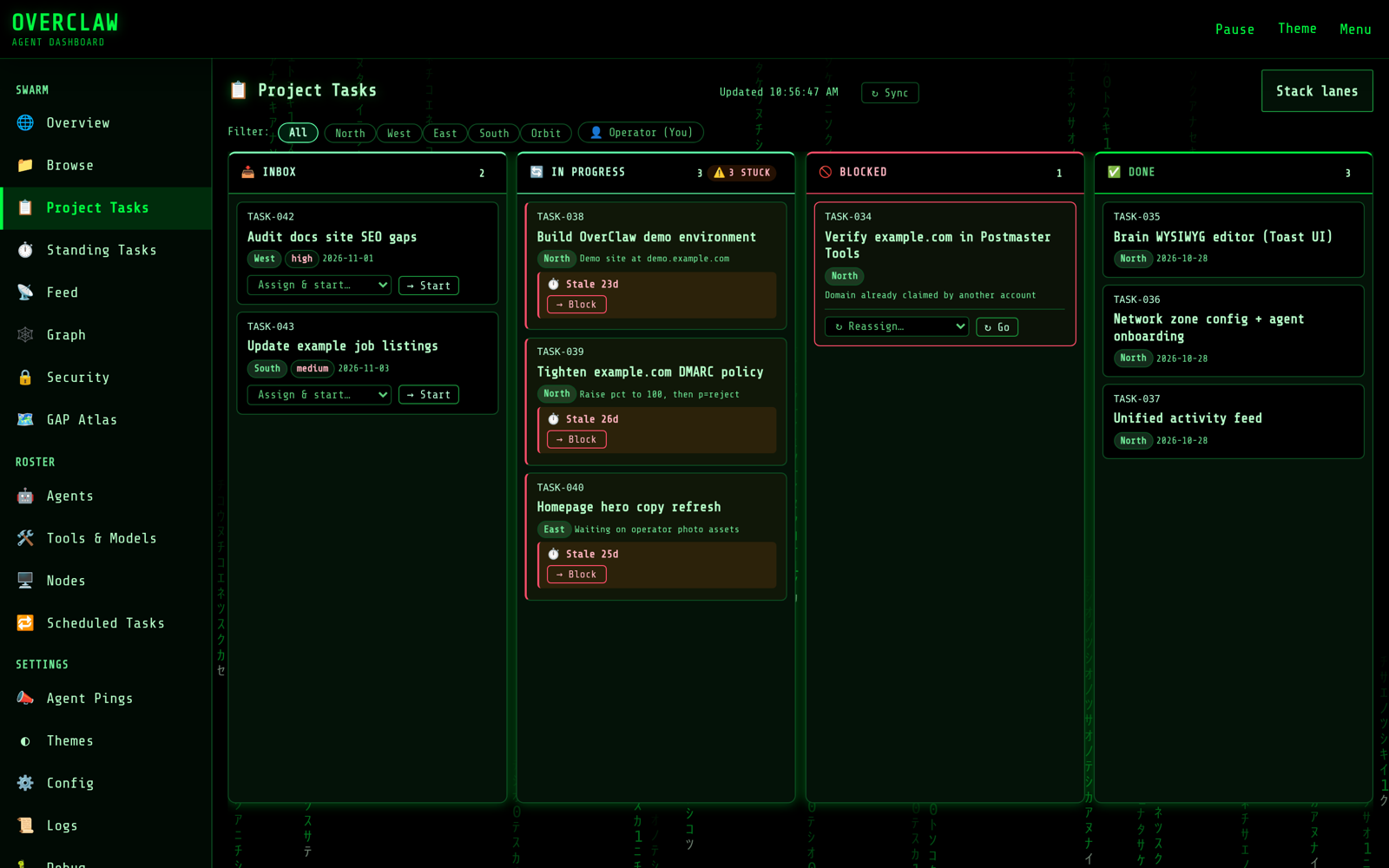
The most important design decision was to make OverClaw harness-agnostic. It began as an OpenClaw companion. It does not depend on OpenClaw anymore. In fact, the OpenClaw agent that used to coordinate my swarm was retired at the end of October, and a chief of staff running on a different harness took over the same job, reading the same Brain and the same Task Board. Nothing else had to change. That is when I knew the harness was the asset, not any one model or vendor.
Why Open Source
I have said this for a long time: open source over proprietary, because of the freedom of speech, not because I am cheap.
Your company’s memory is the most valuable thing an agent touches. It should not be locked inside one vendor’s product, and you should not have to take a vendor’s word for how it is handled. With OverClaw the code is on GitHub under the MIT license. You can read every line, run it on your own hardware, keep the database on your own disk, and point whatever agents you like at it.
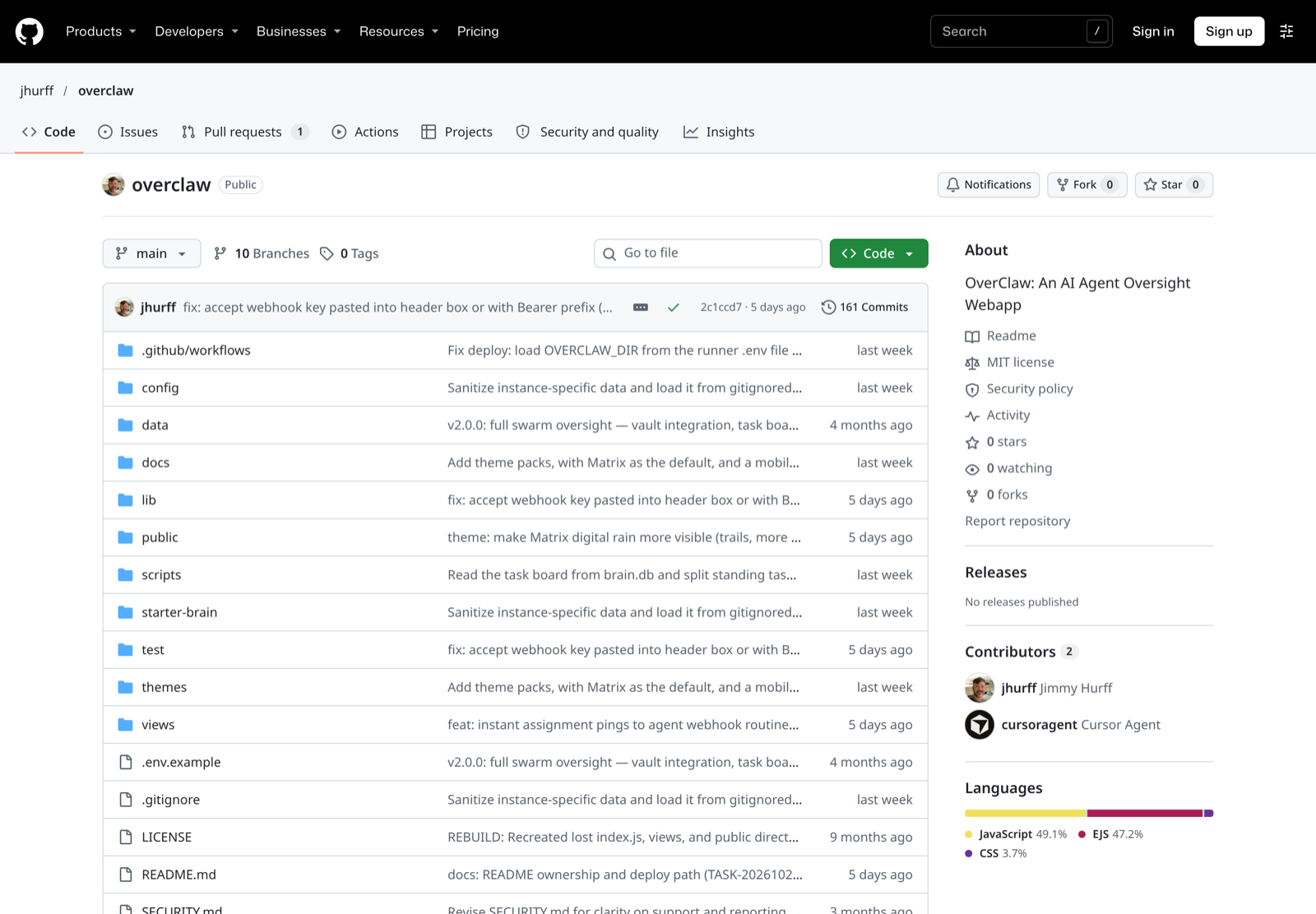
There is a second reason. The agent tooling market is moving faster than anything I have seen in 30 years, including the internet and cloud. Nobody has the operating model figured out yet, me included. Building in the open is how I learn faster, and how other operators can take what works and skip what did not.
What It Looks Like Day to Day
Today 13 agents work in my swarm across five harnesses: Grok Bot, Cursor, Claude Cowork, ChatGPT, and Codex. Each one has a title and a lane: chief of staff, software engineer, DevOps, project analyst, sales and marketing, security, boat technician, legal analyst, UI designer, and more.
The management model is explicit:
- Work lands on the Task Board. Only the chief of staff mints task IDs. When a task is assigned, the owning agent gets an instant ping and picks it up.
- Only the chief of staff messages me unprompted. Everyone else posts status to the Brain and a monitoring channel. I get interrupted for an outage, a security issue, money at risk, or a decision only I can make.
- Heartbeats show who is alive. Anything that goes quiet or stale gets flagged.
- Production needs my yes. Agents propose. I approve. Then they ship.
Here is a real example from this week. My sales agent asked my UI agent to build a new community page for one of our marine businesses. The UI agent built it, opened a pull request, and held it. I said yes. It merged, deployed, and was verified live in under a minute. That is what “the best software engineer you have ever had” looks like in practice: not magic, just good work inside a good system.
The Harness Is the Business
The models will keep getting better and cheaper. That is not where the durable advantage is. The advantage belongs to the companies that build the harness: shared memory their agents can trust, clear roles, real guardrails, human approval where it matters, and the visibility to manage all of it.
That is the business of agent harnesses. It is not a chatbot in a browser tab. It is an operating model.
Agents really can be the best administrative assistant, the best software engineer, and the best research analyst you have ever had. But you would never hire great people and give them no memory, no desk, no manager, and no rules. Do not do it to your agents either.
I am building mine in the open. OverClaw is on GitHub at github.com/jhurff/overclaw. Take it, run it, break it, and tell me what you learn. If you are leading a company through this shift and want help designing the harness, that is the work I do through Advisory Services. Start a conversation.